


Logo contest was organised in 4 institutions. Each partner prepared a disgn of own logo for the competion. Voting for logos was done online. Students, teachers and families could vote for 12h. The Polish proposal has won and will be used in all papers and results created within the project.

Students had an opportunity to deepen into Turkish culture, customs and traditions. They took part in dancing (Zeybek) and archery workshops. Students also visited classes and took part in the lessons.

The delegations could admire the beautiful ancient area of Didim. The location of today’s Didim used to take part around the Apollo temple at the ancient Didyma town. they called the area “Yoran”. Didyma is located in the village of Yenihisar. 4 km Inland from the coast called Altinkum (Golden sand) and 15 kms south of Akköy, near Soke. Didyma was actually a sacred site and not a city, in whose centre was a great temple built in the name of the sun god Apollo. Miletus was a Mycenaean stronghold on the coast of Asia Minor from c. 1450 to 1100 BC. The 13th century BC saw the arrival of Luwian language speakers from south central Anatolia calling themselves the Carians. Later in that century other Greeks arrived.

We could be the witnesses of really big entertainment - school presentation - in public which took place in the local amphitheatre with the presence of local authorities, parents, teachers and families.

Two days of activities were dedicated to cultural visits and to presenting to this group the diversity and richness of two cities: Braga and Porto. We visited the D. Diogo de Sousa Museum and the city of Braga, thus getting to know part of the local history and culture, as well as a little of the Portuguese gastronomy (here we highlight the famous custard tarts, which were, of course, very successful).

The groups visited the Biology and Physics and Chemistry laboratories (in the latter they were able to attend a laboratory activity coordinated by Professor Paula Costa), the Ciência Viva Club (with a demonstration of Robotics by Professor José Mota), the Library (where Professor Ana Cunha was talking, around the books, with those present), the Pedagogical Pond and the Organic Garden (with clarifications by Professor Fernando Mota), the Heritage Club, the Language Club and, finally, the Erasmus room.

with the task of students Afonso Gonçalves and Rafaela Machado, there was a brief presentation of the Portuguese author and literary work that are part of this project: José Saramago and the novel "Blindness". And to which, a continuous act, the screening of the film "Blindness", by director Fernando Meirelles, a faithful adaptation of Saramago's work, was passed.

In a relaxed and healthy atmosphere, those present were challenged to carry out a quizizz on literature: "Name the Author!", in pairs work and in which, once again, the collaboration of Portuguese students was essential: Beatriz Silva, Eva Barbosa, Inês Gonçalves, Inês Silva, João Carvalho and Mateus Oliveira.

They could practice canoeing and paddle boarding, under the supervision of teachers Cristiano Mineiro, Thomai Natsou and Tiago Vieira, with the cooperation of students Beatriz Silva, Inês Gonçalves, João Carvalho, Mateus Oliveira and Rodrigo Ribeiro and where students from the three countries fraternized and developed social and communication skills in English.

Taranto is a coastal city in Apulia, Southern Italy. It is the capital of the province of Taranto, serving as an important commercial port as well as the main Italian naval base. Founded by Spartans in the 8th century BC during the period of Greek colonisation, Taranto was among the most important poleis in Magna Graecia, becoming a cultural, economic and military power that gave birth to philosophers, strategists, writers and athletes. The delegations could vistit The Castello Aragonese which is a fortification in Taranto, Officially called the Castel San Angelo, it was built on the site of older fortifications dating to Greek occupation in the third and fourth centuries BC. In 1481 the low ground in front of the fortification site was excavated to allow the passage of boats, and to create a moated defensive position.

The afternoon was dedicated to the creative writing workshop "No Blind Imagination", designed and promoted by teacher Ana Cunha with the collaboration of Portuguese students Beatriz Silva, Gonçalo Ribeiro, Inês Gonçalves and Mateus Oliveira.

Author & novel introduction: Brief presentation about Alessandro Manzoni and the historical context of "The Betrothed" (Spanish rule in Lombardy). Activity: Show images/videos related to the novel location in Lombardy. Plot Summary & Genre: Listening activity: Students listened to a simplified video summary of the plot. Reading activity: Students read a short text describing the novel's genre (historical novel). Activity: Reorder the plot: Students receive jumbled sentences summarising key plot points and must put them in chronological order. Character introduction: Brief overview of the main characters through monologues (Renzo, Lucia, Don Abbondio, etc.). Activity: Provide adjectives about the characters.

The delegations visited the school, mechanic laborartories, robotic classes, IT rooms and even flight simulator activities - very unusual.

Students had a chance to work with text adaptation: Students, in groups, received an adapted passage from "The Betrothed." They worked together to simplify the language and translate key phrases into English.

Visiting and getting familiar with the school in Cieszyn. The guests could see the classes, learn about educational system, taste the Polish cuisine
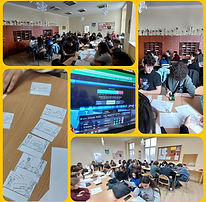
Literary workshops on W. Szymborska and A. Mickiewicz and their artistic works.

Visiting Cieszyn, meeting with the Mayor was a nice chance to deepen into Polish and local culture.

Students intesively took part in literature workshops ( supervised by the teacher Barbara Szczygieł) and little projects dedicated to different international literature and they could choose their favourite novel and present an artistic project reflecting the book.


Also with help of the teacher Barbara Szczygieł students prepared the roleplay to bid the former students farewell.